What “Pokies in South Australia” Can—and Cannot—Tell You
A guide to pokies in South Australia can help you understand the kind of information to check before choosing a venue. It cannot establish that one venue is best for every visitor, or that a game will deliver a particular result. “Best” might mean a place that suits your plans, feels comfortable to you or offers the kind of experience you want. Those are personal judgments, not a single verified ranking.
The same distinction matters when you see claims about the “best paying” pokies. A game’s reputation or a description on a screen does not tell you what an individual session will bring. A venue guide should not turn a broad search for South Australia casino pokies into a promise of higher returns. Nor should the word “casino” in a description be taken as proof that a particular venue has a specific status or feature. Check what a venue itself says, and consider whether the information is relevant to what you need.
Список казино
Choosing pokies in South Australia means finding an option that fits your preferences and checking its terms before you play. Use this list as a starting point for your 2026 search.
1
JeetCity Casino
License
Curacao eGaming (Dama N.V.)
JeetCity Casino lists a Curaçao eGaming licence held by Dama N.V. You can use that licensing detail as one point to check when considering the operator.
2
LuckyVibe
License
Curacao Gaming Control Board OGL/2023/176/0095 (Hollycorn N.V.)
LuckyVibe lists a Curaçao Gaming Control Board licence, OGL/2023/176/0095, held by Hollycorn N.V. Check the licence details as part of your research.
3
Kingmaker
Payout speed
crypto ~90 minutes, fiat 1-5 days
Min. deposit
A$30
Kingmaker lists a minimum deposit of A$30. Its stated payout times are around 90 minutes for crypto and 1–5 days for fiat.
4
Roby Casino
License
Curacao eGaming (Roby Games Ltd)
Roby Casino lists a Curaçao eGaming licence held by Roby Games Ltd. You can consider that information when checking the operator.
5
Playfina Casino
License
Curacao eGaming (Hollycorn N.V., since 2017)
Min. deposit
A$20-30 (depends on the offer)
Playfina Casino lists a Curaçao eGaming licence held by Hollycorn N.V. since 2017. Its minimum deposit is A$20–30, depending on the offer.
6
Vegaz Casino
License
Curacao OGL/2024/1335/0780
Min. deposit
EUR 20
Vegaz Casino lists Curaçao licence OGL/2024/1335/0780. The stated minimum deposit is EUR 20.
7
JustCasino
License
Curacao Gaming Control Board
JustCasino lists a Curaçao Gaming Control Board licence. You can check this licensing detail as part of deciding whether to explore the operator.
8
House of Pokies
License
international iGaming licence – jurisdiction not named in the source
Payout speed
PayID 1-24 hours
Min. deposit
A$30 (PayID from A$10)
House of Pokies lists an international iGaming licence, though the jurisdiction is not named in the source. Its stated PayID payout time is 1–24 hours, and the minimum deposit is A$30, or A$10 with PayID.
9
Ricky Casino
Payout speed
crypto under 1 hour, PayID 1-3 business days
Min. deposit
A$20 (A$30 to qualify for the bonus)
Ricky Casino lists crypto payouts in under an hour and PayID payouts in 1–3 business days. The minimum deposit is A$20, or A$30 to qualify for the bonus.
10
Lucky Dreams
License
Curacao
Min. deposit
A$20 (POLi)
Lucky Dreams lists a Curaçao licence and a minimum deposit of A$20 when using POLi. These details may help you assess whether it suits your search.
South Australia is the geographic focus here: the aim is to help you make sense of the local venue context, rather than provide a list of supposedly winning games. A phrase such as “pokies in South Australia” can refer to different things: finding a venue, understanding what kind of gambling is available, or looking for games believed to pay well. Keeping those meanings separate helps prevent a general guide from sounding more certain than it is.
The word “pokies” is the familiar Australian term for electronic gaming machines. But a broad reference to pokies does not, by itself, tell you what a venue offers, what conditions apply there, or whether a particular game is available. Those details need to be established for the venue and the time you intend to visit. A state-level guide provides context; it is not a substitute for checking the information that applies to a specific place.
Age and regulatory context
You must be at least 18 to gamble in Australia, including on pokies. If you are arranging a visit with other people, keep that age requirement in mind for anyone who might take part. A venue’s setting or the presence of other activities does not change the minimum age for gambling.
At the national level, the Australian Communications and Media Authority (ACMA) is the primary domestic regulator enforcing the Interactive Gambling Act 2001. That is useful context, but it should not be read as a complete account of every rule that may apply to a South Australian venue. National oversight of interactive gambling and the practical requirements that apply at a physical venue are not interchangeable. A guide should not suggest that ACMA’s role alone answers every question about how a local venue operates.
Pokies in Sydney: checking venues and locations
Sydney search results can cover very different locations, so confirm the address, route and venue…
Best Pokies in Canberra: Hours and Access Checks
Online listings can be outdated, and a venue being open does not confirm that its…
This distinction also helps when a page uses broad phrases such as “casino pokies” or “South Australia pokies.” Such wording can blur the difference between physical venues and gambling offered online. The setting matters: a local visit and an online service raise different questions, and one should not be treated as evidence about the other. If your interest is specifically in an in-person venue, focus on details that relate to that venue rather than assuming that general online or casino language describes it.
A careful way to use a South Australia guide is to treat it as a starting point. It can help you frame what you want to know and identify which details need checking, but it cannot turn an unverified claim into a fact. Be wary of confident “best” labels when no clear basis is given. An attractive description is not evidence that a venue will suit you, and a game’s name or theme cannot tell you what will happen during play.
The useful question is therefore not simply which pokies are best, but what information would make a venue appropriate for your own plans. Separate confirmed details from promotional language, and do not assume that a general recommendation applies to every visitor. The basic context is straightforward: gambling is for adults aged 18 and over, and ACMA enforces the national interactive-gambling law. Beyond that, assess claims according to what they actually establish, rather than what the wording may lead you to expect.
Checking Whether a Venue Is Open Before You Travel
A listing that says a South Australian venue is open now is a useful starting point, not confirmation that its pokies are available when you arrive. Online opening labels can be delayed, and a venue’s general trading status may not tell you whether its gaming area is operating. If you are making a special trip, confirm directly with the venue before setting out.
Start with the venue’s own current information, such as its official website or social media page. Look for a recent update rather than relying on a short description copied across directory sites. If the information is unclear, call and ask whether the venue is open and whether the gaming area is operating at the time you expect to arrive. A direct answer is more useful than an automated map label when your plans depend on it.
Be precise about what you need to confirm. A hotel, club or other venue may be open for food, drinks or another service while its gaming area is closed or unavailable. Ask specifically about pokies, rather than treating the venue’s overall opening status as proof. If you are travelling with someone else, make sure the answer covers the time you plan to reach the venue, not merely the moment you call.
Search results can also mix information about different places with similar names. Check the full venue name and its location before relying on a listing. Make sure the contact details belong to the venue itself, and not to a directory or an unrelated business. If a result gives no clear source or appears out of date, treat it as a lead to verify, not a dependable confirmation.
Best Pokies in Perth: Venues, RTP and Access
A practical look at Perth venue access, machine reporting and what RTP can—and cannot—tell you…
This matters especially when you are looking for an early opening, a late visit or a venue that appears to be open at the moment you check. Search engines and map services may display hours supplied earlier by a business or gathered from other listings. They can be helpful for narrowing down possibilities, but a status badge does not necessarily reflect a last-minute change, a temporary closure or the operating status of the gaming area.
If you cannot reach the venue, compare the available information rather than assuming the most convenient result is correct. Look for a recent notice on an official channel and check whether other listings agree. Conflicting hours are a reason to pause and seek direct confirmation, especially if reaching the venue would involve a long journey. Avoid treating an old review, an undated directory entry or a search snippet as a current statement from the venue.
A planned visit can also be affected by practical details that a basic opening label does not answer. You may want to confirm whether entry is available to visitors, whether the area you intend to use is operating, and whether any temporary change affects access. Ask plainly and keep the answer in mind when deciding whether to travel. There is no need to infer availability from a busy-looking venue page or from comments posted by other visitors.
Some people looking for an open venue are also trying to compare payout percentages. Those are separate questions. A venue being open does not establish the return setting of a particular pokie, and a payout figure found online should not be taken as confirmation of what is available on the floor. Keep opening-status checks focused on whether you can visit and use the gaming area; assess game information separately.
Do
Check official websites or social media for recent updates
Call the venue to ask specifically about the gaming area
Verify the full venue name and location
Don't
Rely on automated map labels or short directory descriptions
Assume the gaming area is open just because the venue is open
Trust undated directory entries or old reviews
If the answer changes or cannot be confirmed, reconsider the trip rather than relying on an assumption. You can check again shortly before leaving, particularly if your plans depend on a specific arrival time. When you do get through, note whether the person has confirmed the gaming area itself or only the wider venue. That small distinction can prevent a wasted journey without requiring you to guess from incomplete online information.
For searches about pokies in South Australia that are open now, the most reliable approach is therefore a simple one: use online listings to identify a possible venue, then verify the current status with the venue directly. Treat the words “open” and “open now” as prompts to check, not as guarantees. If no current confirmation is available, plan around that uncertainty rather than assuming the machines will be operating when you arrive.
Searching Near the Airport, CBD or Another Destination
A location-based result is only useful if it refers to the place you intend to visit. A map pin, a short distance label or the word “near” in a listing does not, by itself, establish that a venue is close to your actual starting point or destination. Before changing your plans, check the address and the route on a map, then make sure the listing refers to the same place you had in mind.
Best Pokies in New South Wales: What to Check
Pokie access depends on the specific venue, and a general listing may not confirm that…
Airport searches can be especially imprecise. A request for pokies near a South Australian airport may return results associated with a broad area, a different airport, or a location with a similar name. A result described as being near an airport may still involve a journey that does not suit your itinerary. Confirm the airport and the venue’s address rather than relying on the wording of a result.
The same care applies when looking around a CBD. “CBD” can be used loosely in listings, and a result may be centred on a different part of the city from the one you need. Check the address against your intended destination and consider the actual route, not just a displayed distance. If you are travelling on foot, by car or by public transport, the route can make a nearby-looking result impractical.
Broad regional wording can also lead you astray. A search for pokies in northern South Australia, or near a central South Australian destination, does not identify a particular town or establish that a result is within the area you mean. Add the specific town, suburb or landmark you are travelling to, then verify the place shown in the result. If a place name could refer to somewhere outside South Australia, check the state as well as the name.
“Near me” results depend on the location being used by your device or browser. If that location is unavailable or inaccurate, the results may be centred somewhere you are not. Check the map’s starting point before treating the distance as relevant. If you are planning ahead, use the address of your actual destination rather than relying on your current location.
Location labels can also be confused with state or territory abbreviations. A result that includes “Vic” may point to Victoria rather than South Australia, even if other wording makes it appear relevant. Read the full address and state before travelling. Likewise, a place name such as Parkes should not be assumed to identify a South Australian destination simply because it appears beside a South Australia-related result.
For a more useful comparison, keep the destination consistent while reviewing results: use the same airport, CBD point, town or landmark each time. Then compare the addresses and routes, rather than treating search order or a “nearby” label as a recommendation. A result can help you identify a possible location, but it cannot tell you whether that location matches your plans unless you confirm the details yourself.
This approach is about geography, not a judgement of which venue is better. If you cannot match a result to a clear address and the place you intend to reach, do not rely on it for travel planning.
Online Pokies Searches: The Legal and Payment Limits
Looking for a way to play pokies on your phone or computer is different from planning a visit to a South Australian venue. Online, the central issue is not how close a game is or whether a bonus appears attractive. It is whether the service can lawfully be offered to people in Australia—and what protection you would have if something goes wrong.
The Interactive Gambling Act 2001 prohibits companies from providing real-money online casino games, including pokies, to people in Australia. No Australian online-casino licences have been issued, so there is no Australian-licensed online casino. A site describing itself as serving South Australians does not change that position, and a deposit option or promotional offer is not evidence of Australian authorisation.
Best Online Pokies in Australia: What to Check
A practical guide to Australian rules and the terms, payment options and limits that can…
The law focuses on the operator rather than making an individual player criminally liable for playing on an offshore site. That distinction should not be mistaken for consumer protection. If an offshore casino refuses to pay your winnings, you have no legal recourse in Australia to recover them. A payment going through does not establish that the operator is authorised here, or ensure that you can resolve a dispute.
This matters when an offer is framed around real-money play, a first deposit or a “no deposit” bonus. The wording may make an offer sound low-risk, but it does not remove the legal limits on operators or create a local avenue for resolving a disagreement. Read the conditions carefully, but remember that understanding an offer cannot supply protections that are not available in Australia.
Requests for high betting limits or the “best-paying” pokies can also draw attention away from the more important question: who is operating the service and what happens if a withdrawal is disputed? A claimed payout rate or a polished payment page cannot answer that. Nor does the presence of a familiar payment method establish that a site is licensed or that its claims have been independently confirmed.
The Australian Communications and Media Authority enforces the Interactive Gambling Act 2001 and blocks access to illegal offshore gambling sites; internet service providers must comply with its blocklist. A site being reachable at a particular moment is not proof that it is authorised or that it will remain accessible. Do not treat search results, adverts or a working deposit page as a substitute for legal status.
If you are weighing an online offer against visiting a local venue, keep the distinction clear: online casino services offered to Australians are prohibited for operators, and an offshore dispute may leave you without a remedy in Australia. The promise of a bonus or a large possible win does not change either point.
What to Check at a South Australian Gaming Venue
A venue’s size and the safeguards it has in place tell you more than a claim that it is the “best” place to play. If you are considering a South Australian venue, look for clear information about who can help if gambling stops feeling manageable, and how staff respond when someone appears to be at risk.
A report published by regionriverina.com.au describes a requirement that, from 1 July, venues operating more than 20 gaming machines have a dedicated responsible gambling officer (RGO) on duty whenever those machines are running. The date is not tied here to a specific year, so treat it as a reported rule to confirm with the venue or relevant authority before relying on it. If you visit a larger venue, you can ask whether an RGO is on duty and how to contact them. Their presence is a practical point to check, not a promise that every concern will be resolved in a particular way.
Pokies in Brisbane: Venue Checks and Online Rules
A practical guide to checking Brisbane pokies venues, opening details, payment claims and what online…
The same report says venues were given a one-month transition period to remove certain signage and bring in responsible gambling officers. It also describes a requirement for venues to keep a gambling incident register. That register is intended to capture occurrences such as a patron showing behaviour that may indicate gambling harm. You do not need to know what another patron’s record contains; the relevant question is whether staff know how to respond to a concern and whether the venue has a clear process for getting help.
Pay attention to the placement and purpose of signs as you move around the premises. Signage pointing patrons towards gaming lounges should not be within eyeshot of ATMs or EFTPOS terminals. Signs directing patrons to ATMs should not be within eyesight of gaming machines. These details matter because prompts to keep gambling or obtain more cash can affect decisions in the moment. If a sign seems to direct people in either of those ways from the locations described, raise it with venue staff rather than treating it as a neutral feature.
You can also check whether the venue explains how to speak with staff privately, what happens when a concern is raised, and where its responsible-gambling information is displayed. A polished lounge or a large selection of pokies does not answer those questions. Nor does a venue’s size, by itself, show how consistently safeguards work in practice.
Use these checks to assess the venue’s approach, not to rank South Australian locations or assume that one is risk-free. If staff cannot explain who the RGO is, how to reach them, or how concerns are handled, you have useful information for deciding whether to stay.
Checking Venue Safeguards
Ask if a dedicated responsible gambling officer (RGO) is on duty
Verify that gaming lounge signs are not placed near ATMs
Confirm how to speak with staff privately about concerns
Check where responsible-gambling information is displayed
Why 24-Hour Pokies Claims Need Verification
A “24-hour” label can sound like a clear promise that pokies are available at any time. Treat it instead as a claim to confirm. It may refer to the venue as a whole, a listing’s general opening status or an assumption repeated elsewhere; it does not, by itself, establish when the gaming area is accessible.
This distinction matters when you are planning a trip around late-night or early-morning play. A venue’s public-facing hours may not answer whether its gaming facilities are operating during the same period. Nor does a result describing a place as open now establish that it will remain open when you arrive. Hours can change, and a page that appears current may not have been updated to reflect a change.
Before setting out, look for hours published by the venue itself and check that they apply to the area you intend to visit. If the wording is unclear, contact the venue and ask specifically whether pokies will be available at the time you plan to arrive. Confirm the relevant day as well as the time, particularly if your plans cross from one day into another. Do not rely on a general “open” label as confirmation of gaming access.
If you cannot get a clear answer, plan on the basis that access is unconfirmed rather than assuming a round-the-clock service. That is more useful than treating “24-hour pokies in South Australia” as a verified description of local venue hours. No claim of continuous access should be taken as proof that a particular South Australian gaming area operates without interruption.
Best pokies in Tasmania: venue hours and game returns
Venue opening hours and gaming-area access can differ; listings, return figures and online claims each…
Keep the check narrow: you are confirming the hours for the specific venue and its gaming facilities, not trying to infer them from a broad category or a location description. A venue may have different information displayed across its own pages and other listings. Where those details conflict, ask the venue directly and rely on the answer that specifically addresses pokies access.
The same care applies when a listing gives opening hours without explaining what those hours cover. “Open” can describe the premises generally, while your reason for visiting is more specific. If that distinction is not resolved, the practical answer is not to assume that the machines will be available. A confirmed time for the gaming area is the detail you need before travelling; a broad claim of 24-hour access is not enough on its own.
Crown Casino Searches and the South Australia Query
A reference to Crown alongside South Australia does not establish that a Crown venue is located in the state. Search results can combine a business name with a place name because people are comparing destinations, asking about travel, or looking for pokies. Treat the wording as a starting point, not confirmation of a local venue or its facilities.
If you are trying to find pokies at a Crown venue in South Australia, first establish which venue the information actually describes and where it is. Check the venue’s own current information and confirm the address before making plans. A result that mentions South Australia without clearly identifying a local address should not be used to infer that Crown operates a South Australian pokies room.
The same care applies to claims about the “best” pokies room. Best can mean different things to different people: the atmosphere, accessibility, available facilities or personal preference. Without confirmed venue details and a clear basis for comparison, a ranking would create confidence without helping you make a sound choice. Avoid treating an unsupported label as evidence of quality or suitability.
Understanding "Best" Labels
Labels like "best" are personal judgments rather than verified rankings. They may refer to atmosphere, accessibility, available facilities, or personal preference depending on the visitor's needs.
Questions about the maximum cash payout at pokies need even more precision. A general claim tied to a casino name may not tell you what applies to a particular machine, game or venue. Do not rely on a number copied from an old post or repeated without a clear explanation of what it covers. Before you play, ask the venue directly about the applicable payout arrangements and read any information displayed for the game. If the answer is unclear, pause rather than assuming that a headline figure applies to your situation.
Keep separate the questions of location, venue features and payout conditions. A result that answers one does not automatically answer the others. Confirm the address through a reliable venue source; ask the venue about its facilities and applicable terms; and be cautious with third-party claims that do not identify what they refer to. That approach helps prevent a familiar name from being mistaken for a confirmed South Australian destination, or a broad payout claim from being treated as a promise about a particular pokie.
CBD Clubs, Gambling Limits and Support Tools
If you are considering a club with pokies in South Australia, a CBD label does not tell you whether it suits your needs or what safeguards it offers. Nor does a list of nearby clubs establish that one is the “best”. Treat location and quality as separate questions, and avoid relying on an unverified directory or ranking to make a personal decision.
Best pokies in Melbourne: venue checks and locations
Search results can use broad landmark labels, so venue addresses and routes need checking before…
Before you play, decide what boundary you want to keep. Deposit limits can restrict how much you put in; loss limits can cap what you are prepared to lose; and session time limits can help you leave when the allotted time is over. These tools work best when set before you arrive, rather than adjusted in response to a run of wins or losses. A limit is a boundary, not a way to predict or control the outcome of a game.
Self-exclusion is another option if you want to prevent yourself from gambling at a venue or service. Ask the relevant venue what its process covers and how to request it. Do not assume that an exclusion arranged in one place automatically applies elsewhere. If you are weighing up CBD pokies or club venues, that distinction matters more than a promotional description or a claim that a venue is popular.
BetStop is a national self-exclusion register, but it applies only to Australian-licensed operators and does not bind offshore sites. It should not be treated as protection from every gambling service. In particular, an offshore site’s willingness to accept a registration or payment does not mean it is covered by the same exclusion arrangements.
If you find yourself raising limits, staying longer than planned or returning after deciding to stop, take that as a reason to pause and review your boundaries. You can use the venue’s self-exclusion process, set limits before another session, or step away from gambling altogether. These options do not guarantee a particular outcome; they give you practical ways to act on a decision made while you are not in the middle of play.
Cashless Pokies and the Newcastle Search
“Cashless pokies” can refer to different parts of a gambling experience: how money is brought into a venue, how it is accessed while playing, or how transactions are recorded. The phrase alone does not tell you which arrangement a particular South Australian venue uses. It is not evidence that a venue accepts a specific payment method, nor that cash is unnecessary.
Before relying on a cashless option, check the venue’s own current information or contact it directly. Confirm what the system does, whether it is available where you plan to play, and what steps or conditions apply. Do not assume that a payment method used elsewhere will work at a local venue. If you would rather not use a cashless arrangement, clarify what alternatives are available before travelling.
The same care applies to a request for the best pokies in Newcastle, South Australia. Newcastle is not a South Australian destination, so those place names do not point to a clearly matching local area. A result that combines them may be referring to Newcastle elsewhere, using broad wording, or mixing information from different locations. Check the stated city and state independently rather than treating the wording as proof that a venue is in South Australia.
Keep the two questions separate: first establish where the venue is, then confirm what payment arrangements it offers. A cashless label does not establish a venue’s location, and a location result does not confirm that a particular cashless system is available. If either detail remains unclear, pause before making plans or carrying money on the assumption that the arrangement will suit you.
These checks are especially useful when a short listing leaves out practical details. Look for information tied to the specific venue, not a general statement about pokies in the state or a result that happens to include Newcastle. That way, you can avoid confusing a place name with a verified South Australian destination, or a broad cashless description with a confirmed payment option.
Geelong Pokies: Hours, Access and What Listings Show
A practical look at listing limits, venue access, gaming safeguards and the legal position on…
How Pokie Returns and Individual Spins Work
A “best” pokie claim can sound like a straightforward comparison, but a game’s title alone does not tell you its return setting. A specialist review reports that some game providers let casinos choose from more than one RTP setting for the same pokie. That means a game available at two venues may not have the same stated return percentage in both places.
RTP, or return to player, is a percentage used to describe a game’s theoretical return over play. It is not a forecast of what you will receive during a visit, nor a promise that a particular session will end in profit. Even when a return figure is published, check that it applies to the specific version and setting of the game you are considering. Without that detail, comparing figures may not be meaningful.
The outcome of each pokie spin is determined by a Random Number Generator, and each spin is an independent event. A run of wins does not make a loss more likely on the next spin, and a run of losses does not make a win due. Previous results do not change the next result.
Best Pokies in Adelaide: What Players Can Verify
A practical guide to interpreting RTP and checking Adelaide venues, online options and payment-related searches…
This matters when weighing claims about the best pokies in South Australia. A high stated RTP, where confirmed for the exact setting, describes a theoretical feature rather than a reliable way to choose a winner. It cannot tell you what will happen in your next spin or make one session predictable.
For a careful comparison, look for the RTP information for the precise game version and venue, and treat broad “best paying” language cautiously if it gives no setting or supporting detail. If you cannot establish that the figure applies to that game in that venue, it is not a sound basis for comparing South Australia pokies. A return percentage can help explain a game; it cannot remove the uncertainty of individual spins.
What is the legal age for online gambling in Australia?
You must be at least 18 to gamble online in Australia.
Are online pokies legal for Australian players?
No Australian-licensed online casino operates, and companies cannot legally offer real-money online pokies to Australian residents without a domestic licence. The law targets operators, not players, so Australians can legally play on offshore sites that accept them, but they have no legal recourse in Australia if one refuses to pay winnings.
What is the cost-benefit calculation of casino promotions?
Check the wagering requirement and any cash-out cap before accepting an offer. For example, a $500 bonus with a 40x requirement means $20,000 in bets before winnings can be withdrawn; a 35x requirement on a $500 deposit plus a $500 bonus means $35,000 in bets.
Can casinos change the RTP of their games?
Yes. Some game providers let casinos choose among multiple RTP settings, so the same pokie can have different return percentages at different casinos.

 Fair Go Casino Bonus Australia: Welcome Offer and Terms GuideFair Go Casino Bonuses and Welcome Offer for Australia The headline value is ...
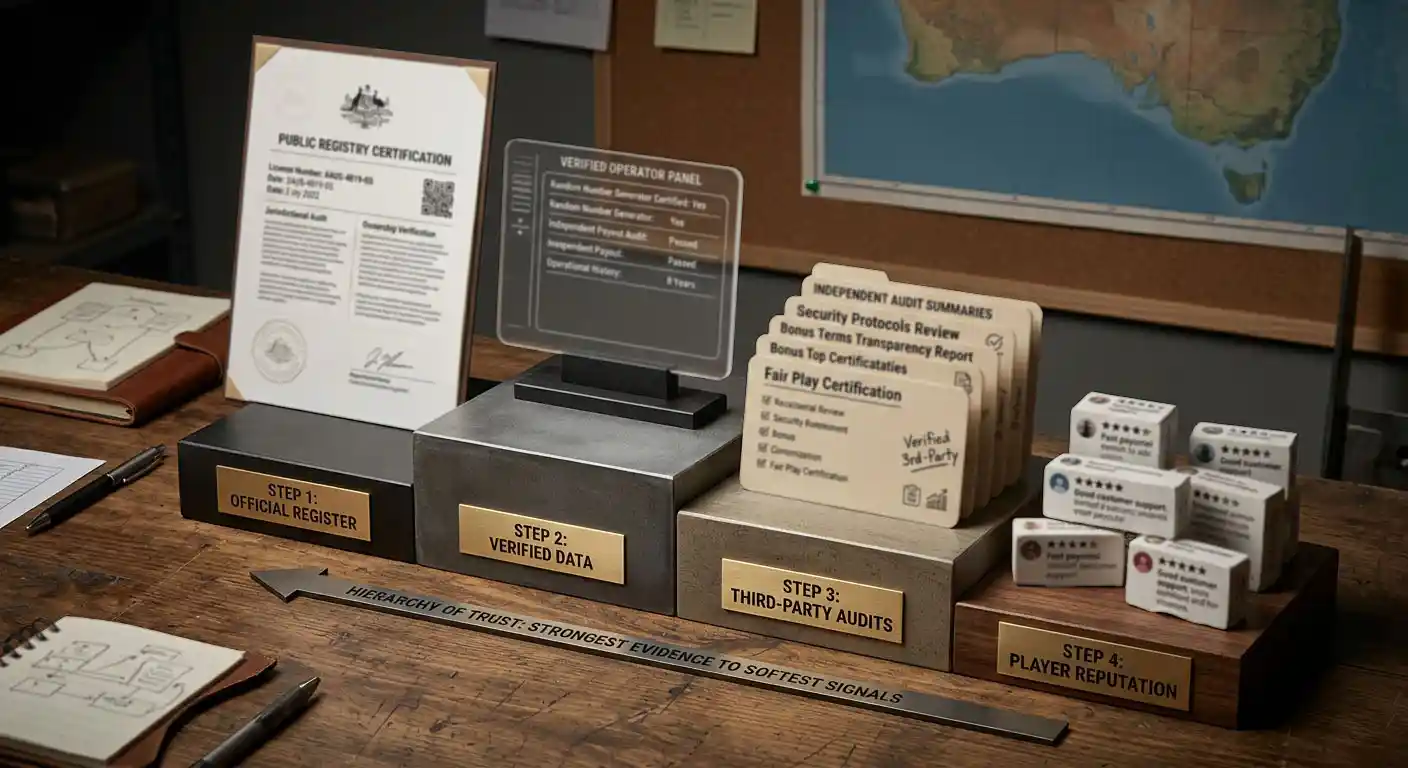 Is Fair Go Casino Legit? Trust, Reputation and Licence ChecksIs Fair Go Casino Legit? Trust, Reputation and Licence Checks A trust assessm...